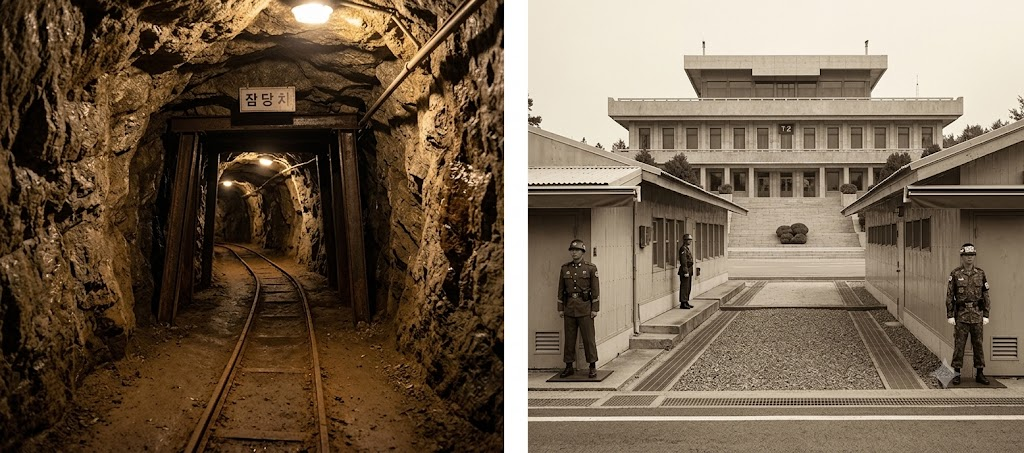
- Just 52 kilometers north of downtown Seoul lies one of the most heavily fortified frontiers on planet Earth: the Korean Demilitarized Zone (DMZ).
- Most international travelers join day tours expecting watchtowers, barbed wire, and stoic soldiers staring across the Military Demarcation Line.
- Yet the most chilling chapter of the Cold War on this peninsula was fought completely out of sight—deep beneath the bedrock.
- Today, let’s peel back the curtain on the Third Tunnel of Aggression: how an intercepted plot, deep-drilling water probes, and a ridiculously absurd excuse exposed North Korea’s covert subterranean war.
- In October 1978, joint South Korean and U.S. forces uncovered a massive subterranean passage carved deep into solid granite, located merely 4 kilometers south of the truce village of Panmunjom.
- The dimensions were staggering: 1,635 meters long, roughly 2 meters wide, and 2 meters high, plunging up to 73 meters beneath the surface.
- Military engineers calculated with absolute horror that this concrete-reinforced tunnel was engineered to quietly funnel up to 30,000 fully armed special forces soldiers straight into the heart of Seoul within a single hour.
- It wasn’t an accidental cave or a coal mine; it was a lethal, subterranean invasion highway designed to bypass the heavily guarded surface border entirely.
- How did this paranoid engineering feat even begin? To understand, we have to look back at the erratic, bunker-mentality paranoia of North Korean leadership in the 1970s.
- Convinced that a surprise blitzkrieg could reunite the peninsula under communist rule, Pyongyang ordered its miners to blast through miles of unyielding granite using only hand-held explosives and pickaxes.
- To avoid detection by seismic monitoring equipment on the South Korean side, workers had to time their dynamite detonations to coincide with natural thunder or artillery training sounds.
- They even painted the interior walls of the tunnel black and staged coal deposits to falsely claim it was an abandoned anthracite mine if discovered.
- But the plot began to unravel thanks to an unexpected informant: a high-ranking North Korean defector who walked across the border and whispered a chilling warning about underground invasion paths.
- Armed with this intelligence, South Korean and U.S. engineers began drilling vertical exploratory holes across suspected zones, playing a high-stakes game of blind man’s bluff with dynamite.
- During one routine drilling operation, a pipe pulled back from the bedrock suddenly gushed water that had been pressurized from deep underground channels—and the drill bit came back covered in fresh soot.
- The trap had been sprung; the engineers had struck the exact concrete-lined ceiling of the secret passage.
- When South Korean soldiers first lowered a camera down the narrow borehole, they stared in disbelief at an electric-lit underground military corridor running right toward the South.
- When a joint reconnaissance team attempted to enter the newly discovered shaft, North Korean forces opened heavy machine-gun fire from inside, killing a brave U.S. Navy officer and a South Korean soldier in the pitch-black darkness.
- To neutralize the threat of infiltration, engineers subsequently sealed the original entry points with massive concrete blockades, leaving only a secure, tourist-accessible side-shaft for the world to witness.
- When the United Nations Command confronted Pyongyang with undeniable physical proof of the invasion tunnels, North Korea’s response entered the hall of fame for absurd geopolitical gaslighting.
- With a straight face, Pyongyang officials broadcasted to the world that they were innocent, claiming the tunnels were actually abandoned coal mines and that South Korea had painted the granite black themselves as a theatrical propaganda stunt.
- Today, standing inside the damp, echoing concrete tube of the Third Tunnel feels less like a historical museum visit and more like walking through the physical bowels of a Tom Clancy techno-thriller.
- Visitors must strap on hardhats, descend a steeply sloped subterranean concrete shaft built by modern engineers, and crouch through the claustrophobic low ceilings where North Korean miners once swung their picks.
- You can still touch the raw drill marks blasted into the solid rock face, silent testaments to an era when the Cold War hovered on the absolute razor-edge of total nuclear annihilation.
- Standing at the thick concrete bulkhead blocking the final dividing line—where North Korean guards literally sit just meters away behind a glass partition—sends an electric shiver down your spine.
- It is a surreal, sobering reminder that Seoul’s dazzling modern skyline and K-pop culture exist right on top of an active, heavily armed geopolitical fault line.
- Walking through this dark, damp underworld strips away all the glamorous illusions of travel, confronting you with the raw, terrifying survival instincts of a divided nation.
- If you want to look past the neon lights and experience the true, high-stakes tension that shaped modern South Korea, you must take the journey out to the DMZ.
- Strap on your hardhat, keep your camera ready, and prepare to walk through the most audacious underground conspiracy in modern military history.
Insider Playbook: Exploring the DMZ & Third Tunnel
| Category | Insider Tip |
| The Starting Point (Imjingak Park & Peace Nuri Park) | Board your organized DMZ tour bus early from Seoul and make your first stop at Imjingak Park. Stand by the poignant Freedom Bridge and view the rusted steam locomotive riddled with over 1,000 bullet holes from the Korean War. |
| The Architectural Climax (The Third Tunnel Descent) | Skip the walking option if you want to save your knees and take the monoton-driven shuttle train down the steep sloping incline straight into the core of the Third Tunnel. Once inside, wear your hardhat carefully as the granite ceiling drops significantly in certain sections! |
| The Panoramic Outlook (Dora Observatory) | Head up to the Dora Observatory right near the border. Through the high-powered coin-operated telescopes on the viewing deck, you can gaze directly across the DMZ into the eerie, silent North Korean propaganda village of Gijeong-dong. |
| The Grand Finale: Unification Village & Camp Greaves | Wrap up your DMZ expedition by stopping by the Unification Village (Tongilchon) to taste authentic local DMZ-grown agricultural products and purchase rare North Korean souvenir currency before heading safely back to the neon comforts of Seoul. |