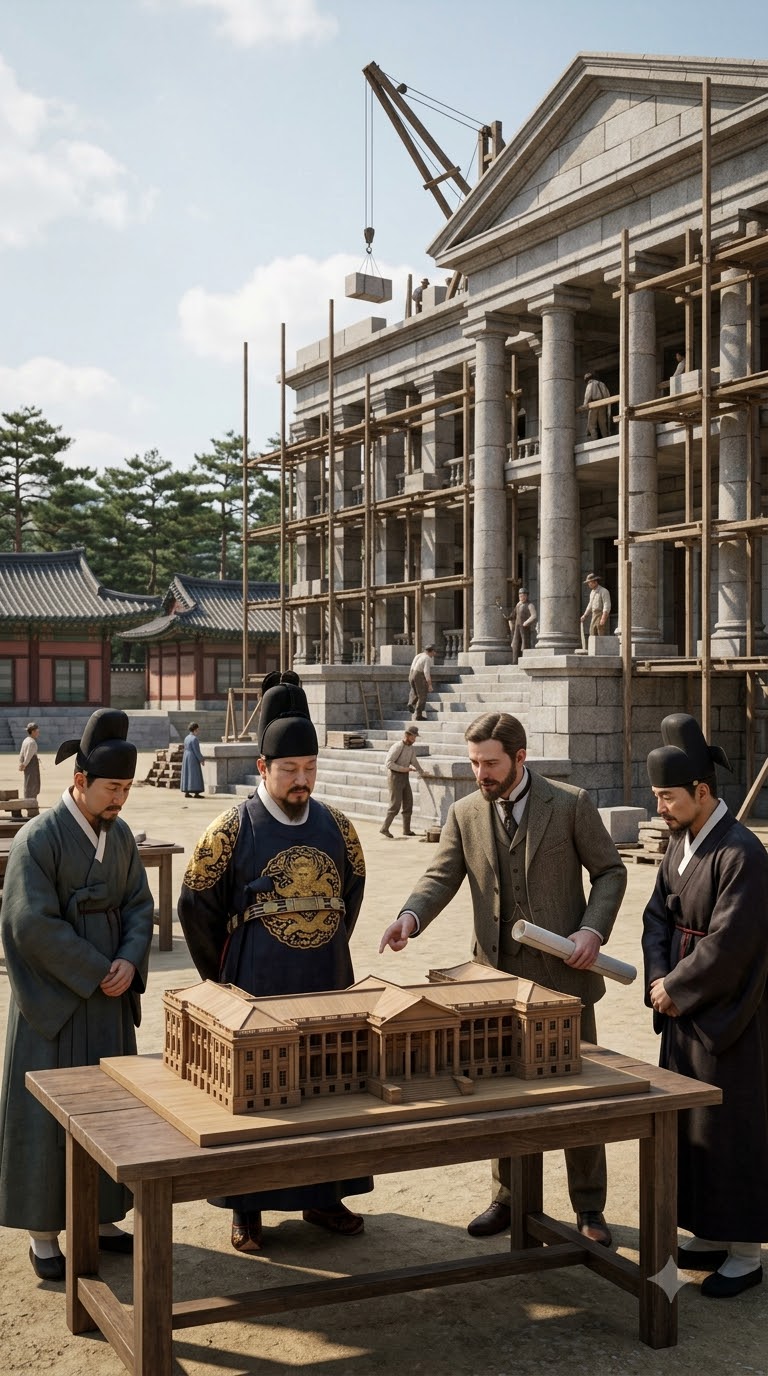
- If you step past the traditional stone gates of Seoul’s Deoksugung Palace, you will experience one of the most jarring architectural whiplashes on planet Earth.
- Nestled right beside centuries-old, sweeping wooden tiled roofs and ancient dragon-carved pavilions sits a blindingly white, neoclassical Western mansion straight out of 18th-century London or Paris.
- Giant neoclassical marble pillars, symmetrical European balconies, and grand stone staircases stare down at royal pine trees as if a stray palace from the French Riviera accidentally crash-landed into a Korean dynasty.
- This bizarre, mind-bending anomaly is Seokjojeon, a stone-built European palace constructed right in the dead center of a traditional Korean royal court.
- To understand why a Korean emperor suddenly decided to live in a Western palace, we have to look back at the agonizing, blood-soaked twilight years of the Korean Empire at the turn of the 20th century.
- In 1897, King Gojong was completely surrounded by aggressive foreign vultures—Imperial Russia, Japan, and Western powers—all carving up the Korean peninsula like a geopolitical pie.
- Desperate to drag his crumbling kingdom into the modern age and prove to the arrogant Western powers that Korea was not a backward barbarian state, Gojong declared the birth of the modern Korean Empire.
- He realized that wearing traditional silk robes and sitting on a wooden throne would no longer deter foreign invaders who measured a nation’s power in steel, concrete, and industrial might.
- In 1900, Gojong commissioned British architect John Mcப்பாடு to design a sprawling, state-of-the-art European palace where he could conduct Western-style state diplomacy, host foreign ambassadors, and sleep on a modern mattress.
- It took ten grueling years of construction, involving imported British carpets, crystal chandeliers from Paris, and modern flushing toilets shipped across oceans.
- But by the time the palatial Western mansion was finally completed in 1910, the tragic irony of history had dealt Gojong a fatal blow.
- Before Gojong could even properly move into his dream European palace, the Japanese Empire had aggressively annexed the Korean peninsula, stripping him of his crown and reducing his empire to ashes.
- Instead of functioning as the proud administrative heart of a modernized, independent Korea, Seokjojeon was weaponized by the Japanese colonial government as an art gallery to mock Korean heritage.
- For decades, the magnificent neoclassical halls echoed with foreign laughter and colonial indifference, stripping away the sovereign dreams embedded in its marble floors.
- Following liberation and the devastating scars of the Korean War, the building was used for various government offices, slowly decaying while citizens walked past its historic facade without a second glance.
- It wasn’t until recent years that the South Korean government meticulously restored Seokjojeon back to its original 1910 imperial blueprint, right down to the reproduced British-style antique furniture.
- Today, walking through its polished hardwood floors feels like stepping directly into a historical time capsule of a king’s heartbreaking final gamble for survival.
- When you stand on the front balcony overlooking the royal gardens, you can almost hear the ticking clocks of an empire racing desperately against time.
- The juxtaposition of traditional wooden Korean pavilions on your left and a neoclassical white marble palace on your right creates a surreal visual metaphor for a country caught between two entirely different worlds.
- International travelers often wander into Deoksugung expecting another standard Asian palace tour, only to have their minds blown by this Western architectural phantom.
- Unlike the massive, sprawling crowds at Gyeongbokgung, Deoksugung’s central location in the bustling Jeong-dong financial district gives it an intimate, melancholic urban charm.
- You can sit on a stone bench just meters away from the mansion, sipping iced coffee while office workers in sharp suits rush past historic brick walls.
- The palace grounds also transform into a magical wonderland at night, with warm yellow lights casting dramatic shadows across the neoclassical marble pillars.
- It is a physical monument to a king’s desperate ambition, national heartbreak, and the turbulent birth pangs of modern Seoul.
- If you want to touch the most complex, Western-influenced chapter of Korea’s royal history without boarding a flight to Europe, this bizarre marble palace is waiting for you.
Insider Playbook: Exploring Deoksugung & Seokjojeon
| Category | Insider Tip |
| The Starting Point (Daehanmun Gate & Jeong-dong Stone Wall Alley) | Enter through Daehanmun, the eastern gate facing the bustling City Hall plaza. Before entering the courtyard, take a brief detour to walk along the legendary Jeong-dong Stonewall Walkway, one of Seoul’s most romantic historic paths. |
| The Architectural Climax (Seokjojeon Imperial Museum Tour) | To enter the interior of the Western palace (Seokjojeon), you must book online in advance via the official royal heritage website. Inside, docents guide you through the recreated imperial dining rooms, bedrooms, and throne rooms fitted with 1910s European furnishings. |
| The Hidden Contrast (Jeontokjeon & Modern Pavilion) | Stroll behind Seokjojeon to experience the ultimate visual mind-fuck: traditional Korean royal halls sitting mere meters away from the European mansion, perfectly capturing the divided soul of the late Korean Empire. |
| The Grand Finale: Jeong-dong Observatory Sunset View | Wrap up your tour by stepping out of the palace and heading straight to the nearby Seoul City Hall Seosomun Annex (Jeong-dong Observatory on the 13th floor). Grab a cheap cup of coffee and enjoy a breathtaking, elevated bird’s-eye view looking straight down into the entire courtyard of Deoksugung Palace and Seokjojeon. |