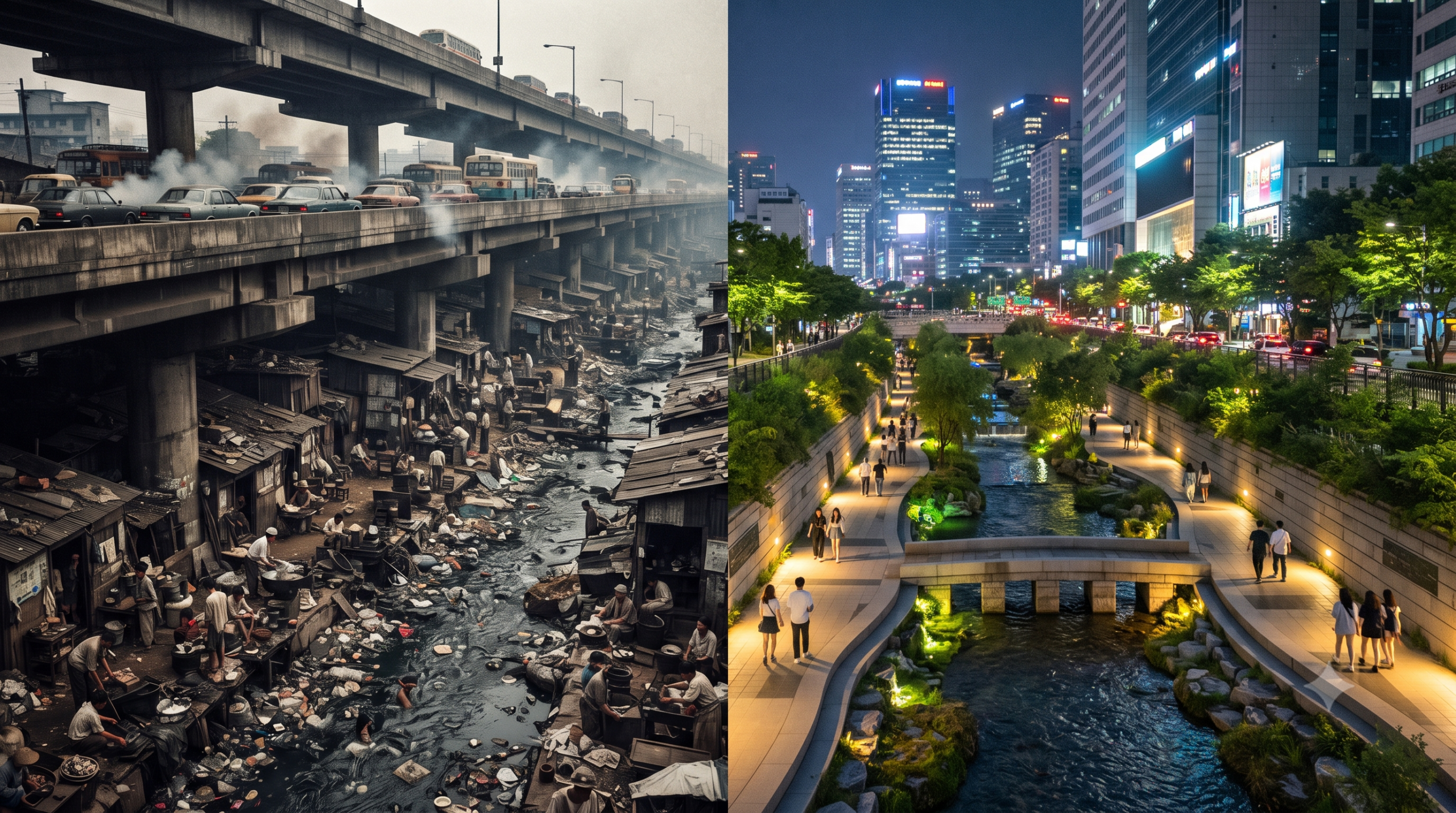
- If you walk through the ultra-modern neon-lit canyons of downtown Seoul today, you are actually strolling right above a ghost.(cheonggyecheon)
- Buried deep beneath the smooth asphalt and roaring traffic of a concrete highway lies a centuries-old river that literally bled, sweated, and wept alongside the birth of modern Korea.
- For over 500 years during the Joseon Dynasty, this winding natural stream served as the life-giving aorta of the capital, where royal palaces reflected off its clear waters and commoners washed their clothes while gossiping about the court.
- But as the Korean War came to a devastating close in 1953, turning the city into a smoking ruin, this once-sacred waterway suffered a grim and tragic fate.
- Millions of desperate refugees flooded into Seoul with nothing but the clothes on their backs, setting up illegal shantytowns right on top of the dry, trash-filled riverbanks.
- Within months, the historic stream transformed into an open-air sewer overflowing with poverty, disease, and the raw, desperate survival smells of a broken nation.
- The government looked at the stinking, chaotic shanties cutting through the heart of the capital and decided the only cure was total, unapologetic erasure.
- In the name of aggressive modernization and economic miracles, heavy machinery moved in to bury the shame completely out of sight.
- Workers poured massive concrete slabs directly over the water, entombing the winding river in absolute darkness and turning its bed into a multi-lane municipal garbage dump.
- Right on top of that suffocating concrete tomb, engineers erected a colossal, roaring elevated highway that sliced the city in half.
- To the military regime of the 1960s and 70s, that roaring highway wasn’t just a road; it was a roaring middle finger to poverty and a glittering monument to South Korea’s industrial rocket ship.
- Beneath the freezing, grease-stained shadows of that highway, thousands of small-scale merchants, metalworkers, and displaced families formed the invisible engine rooms of the “Miracle on the Han River.”
- They worked eighteen-hour days in claustrophobic alleys, manufacturing everything from spare auto parts to fake designer clothes to send their kids to college.
- For decades, Seoul citizens grew up knowing the stream only as a gray, thunderous overpass that smelled endlessly of exhaust fumes and stale fried food from neighboring markets.
- The river was completely forgotten, written off as a permanent casualty of rapid urban growth—until a radical politician decided to commit political suicide.
- In 2002, a charismatic mayor named Lee Myung-bak looked at the decaying, structurally unsafe highway and proposed something that shocked the entire nation: “Let’s tear the highway down and bring the river back.”
- Experts laughed, economists panicked, and thousands of street merchants staged violent protests, screaming that removing the highway would cause catastrophic traffic gridlock and ruin their livelihoods.
- Despite the fierce political bloodshed, the bulldozers rolled in during 2003, ripping apart the concrete deck in one of the most audacious urban gambles in world history.
- When the heavy slabs were finally lifted, Seoul held its collective breath—revealing decades of accumulated sludge, rusted iron skeletons, and an unbearable stench that rolled across downtown.
- Skeptics predicted total urban collapse, but magic happened when the fresh water of the Han River was pumped in to flush out the ancient channel.
- Within months, green moss replaced gray grime, native fish returned to clear pools, and the temperature in downtown Seoul dropped by several degrees compared to the surrounding asphalt jungle.
- Today, this 11-kilometer linear park is hailed globally as the ultimate blueprint for eco-friendly urban regeneration, copied by city planners from New York to Tokyo.
- Yet, if you sit quietly by the stone footbridges at night and listen closely to the rushing water beneath the LED lights, you can still hear the phantom echoes of the shantytown dwellers and ironworkers who built this city with bare hands.
- Walking this stream isn’t just a relaxing evening stroll; it is an emotional trek straight through the paradoxical guts of a nation that paved over its soul, only to dig it back up and turn it into a masterpiece.
- If you want to understand how Seoul morphed from a war-torn ruin into a global cultural superpower in less than a lifetime, you don’t need a textbook—you just need to walk the banks of the river they tried to bury.
Insider Playbook: Exploring Cheonggyecheon Stream
Beyond a simple tourist walk, here is a locally optimized navigation playbook designed to extract the maximum narrative and sensory experience from Seoul’s most famous restored waterway.
| Category | Insider Tip |
| The Starting Point (Cheonggye Plaza & Spring Tower) | Begin your journey at the official source of the stream marked by the iconic multi-colored spiral sculpture (The Spring). Stand right by the massive two-tier waterfall to wash away the sensory noise of the surrounding skyscrapers and capture your opening establishing shot. |
| The Historic Paving Stones & Supyogyo Bridge | As you walk downstream past the Gwanggyo bridge, look down at the traditional stone markers and replicas of historical bridges like Supyogyo. This is where you can visually trace the transition from Joseon dynasty stone architecture to the heavy concrete eras of the 20th century. |
| The Bridge-Underpass Art Spaces | Pay close attention to the massive concrete pillars supporting the modern road bridges overhead. Local curators frequently turn these dark structural underpasses into shifting digital media art galleries, creating a striking visual contrast between cold industrial support beams and fluid, organic light shows. |
| The Grand Finale: Gwangjang Market Link | Do not just walk the entire length endlessly. Around the middle section near Sewoon Plaza, slip up the stairs and duck into Gwangjang Market. Emerging from the ultra-clean stream into the chaotic, smoky, 100-year-old alleyways filled with mung bean pancakes and spicy noodles delivers the ultimate punchline to Seoul’s dual identity. |