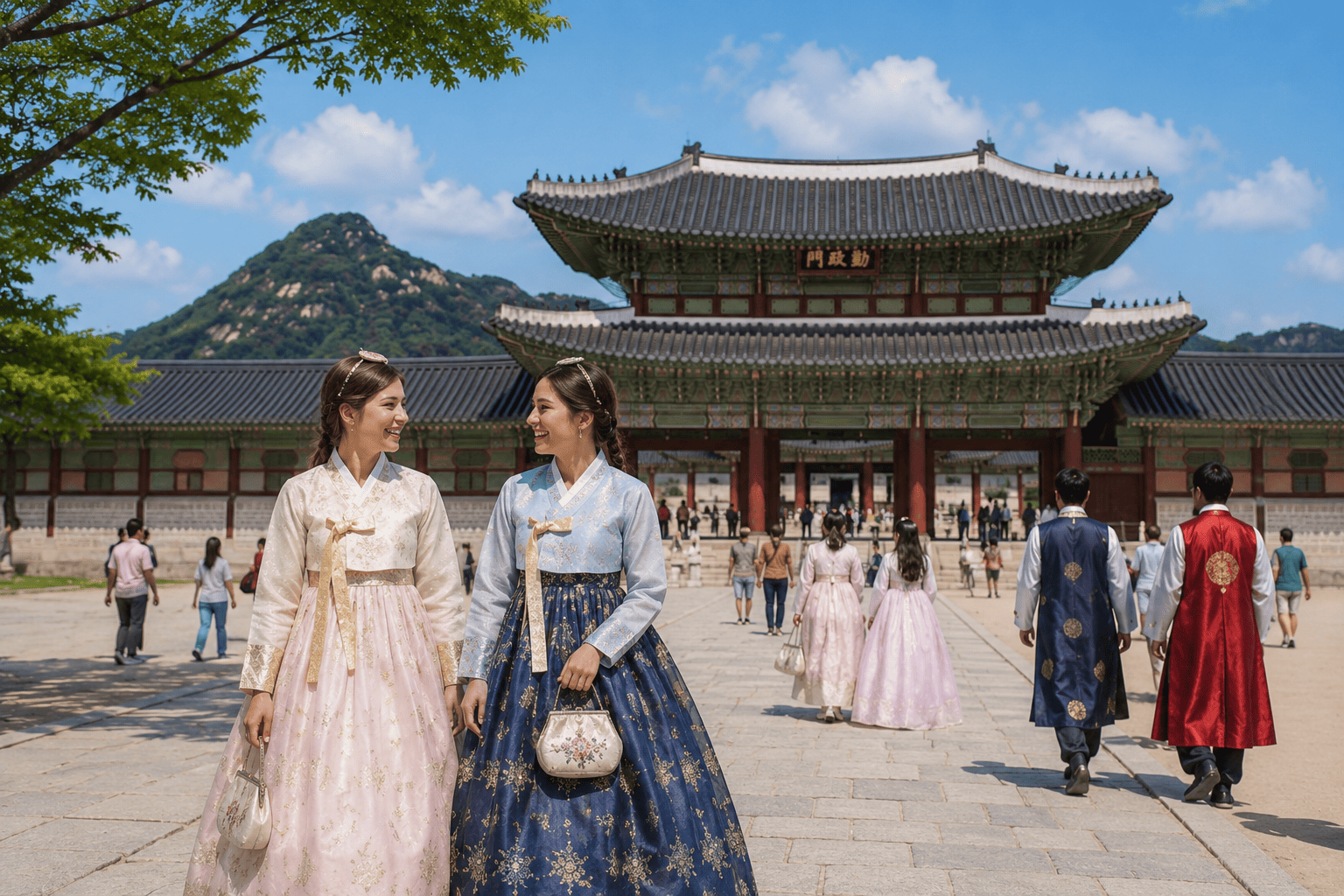
- After lying in ruins for 273 years, Gyeongbokgung was resurrected in 1865 by Heungseon Daewongun, the regent and father of King Gojong.
- His goal was straightforward: rebuild royal authority by constructing a gargantuan complex of over 500 buildings and 7,200 rooms.
- To fund this massive project, the royal court issued Dangbaekjeon (an emergency coin with 100 times nominal value), triggering catastrophic hyperinflation across the nation.
- The palace was completed in 1868 at immense economic cost, but peace was short-lived.
- In 1895, Empress Myeongseong was brutally assassinated by Japanese agents inside Okhoru Pavilion, prompting King Gojong to flee to the Russian legation and abandoning the palace once more.
- Following the Japanese annexation of Korea in 1910, the colonial government systematically dismantled Gyeongbokgung.
- Over 90% of the wooden halls were torn down and auctioned off for scrap timber or private villas.
- The Crown Prince’s residence (Jaseondang) was shipped to Tokyo for a private museum, where its stone base remained after burning down in the 1923 Great Kanto Earthquake.
- In 1926, the Japanese built the massive neoclassical Government-General Building right in front of the throne hall, deliberately blocking the visual and spiritual heart of Korea.
- The iconic front gate, Gwanghwamun, was forcibly relocated to the eastern wall to make room for the colonial headquarters, only to have its wooden pavilion incinerated by artillery during the Korean War.
- In 1968, Gwanghwamun was rebuilt using cheap reinforced concrete and aligned incorrectly to match the Japanese headquarters—leaving it tilted 3.75 degrees and pushed back 14.5 meters off its original axis.
- By the late 20th century, barely 36 original wooden structures (roughly 7% of the original palace) remained standing.
- The tide turned in the 1990s: the colonial headquarters was demolished in 1995, and the concrete gate was demolished and properly rebuilt with traditional timber in 2010.
- In late 2023, the ceremonial royal elevated platform (Woldae) in front of Gwanghwamun was fully restored to its historical footprint.
- Even with three decades of continuous restoration, Gyeongbokgung today is only at roughly 25–30% of its original scale (around 130 buildings).
- Full restoration targeting about 40% (205 buildings) is slated for completion by 2045.
- Despite being a work in progress, Gyeongbokgung now welcomes over 6 million visitors annually, with international tourists making up nearly half of the crowd.
- What was once systematically destroyed to erase Korean identity has now become the single most celebrated symbol of Korean culture worldwide.
💡 Practical Travel Logistics
| Category | Details |
| Address | 161 Sajik-ro, Jongno-gu, Seoul |
| Guard Changing Ceremony | 10:00 AM & 2:00 PM daily at Gwanghwamun / Heungnyemun Plaza (20 mins, Free) |
| Admission Fee | Standard: 3,000 KRW / Hanbok Wearers: 100% FREE |
| Hanbok Rental | Available around Gyeongbokgung Station (approx. 15,000 – 25,000 KRW for 2 hrs) |
| Transit Access | Line 3 Gyeongbokgung Station (Exit 5) or Line 5 Gwanghwamun Station (Exit 2) |
| Parking | 5,000 KRW for first 2 hours (Standard cars), 800 KRW per additional 10 mins |
