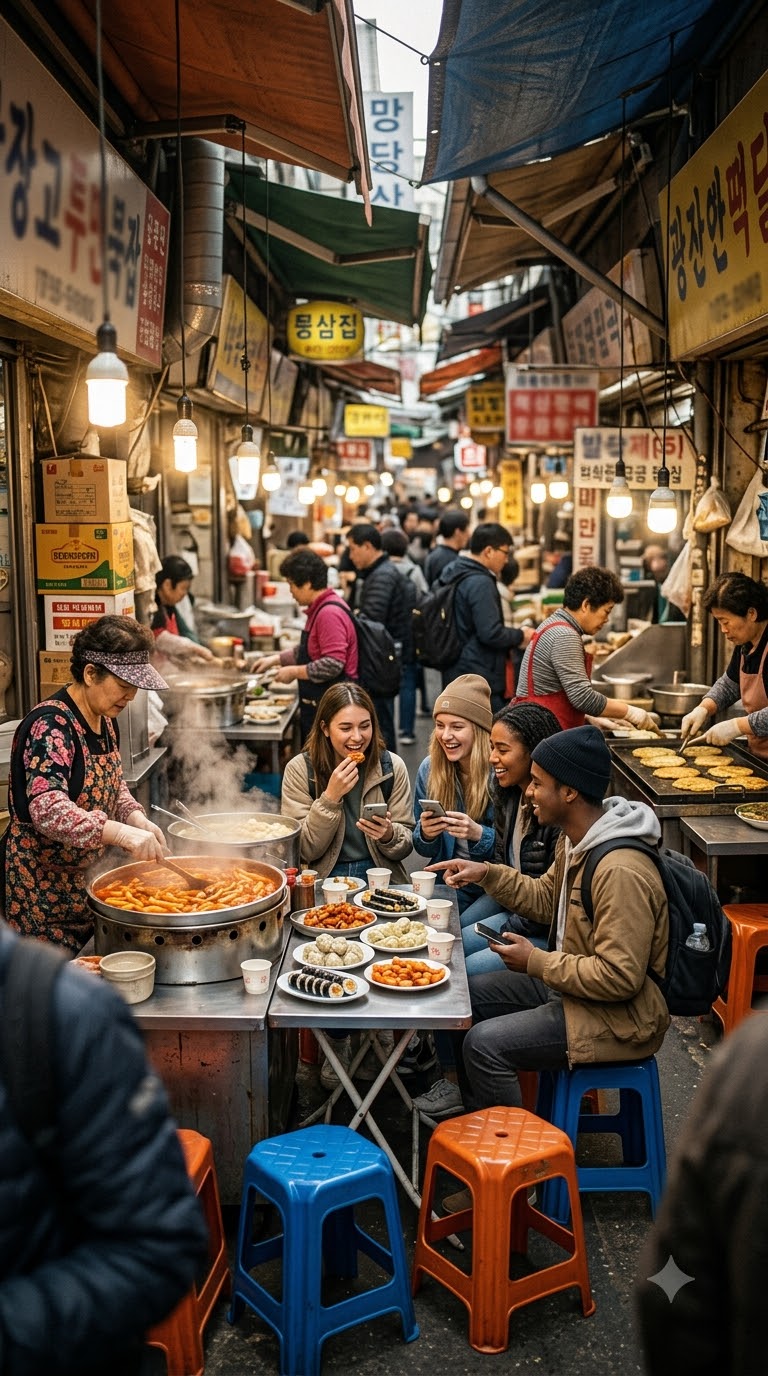
1. I have a fierce, unapologetic obsession with the raw, unfiltered smell of capital that oozes out of gritty, antique traditional markets.
2. While countless foreign media outlets call Gwangjang Market a culinary sanctuary, through the cynical eyes of someone who survived the trenches of inbound tourism, this place is no mere market.
3. Born in 1905 amidst the creeping tide of Japanese colonial capital, it survived the ashes of war and fused the blood and sweat of South Korea’s compressed growth into a massive, living economic relic.
4. Foreign tourists go wild over the sizzling sound of decades-old mung bean pancakes, but the real core of Gwangjang Market, at least to me, is the ruthless velocity of working-class capital flowing behind those thin batter discs.
5. The exact reason why this massive rectangular block in the middle of Jongno has survived over half a century against the blade of urban redevelopment lies in its hidden merchant cartels and the naked face of Korean capitalism.
6. In a world flooded with identical global franchises, why on earth do high-end global travelers and food directors keep crawling down this congested, stinky alley in Jongno?
7. To find the answer, you need to throw away those basic, cliché Instagram photos of Mayak gimbap and walk deep into the heavy, genuine “urban noir” narrative that this market holds.
8. Gwangjang Market’s origin was never some pure traditional heritage; it was the very first joint-stock permanent market built by domestic capital like Hanseong Bank to aggressively block Japanese colonial control over Joseon’s commercial districts.
9. From its very birth, this space was never a naive country fair, but a cold business ring where local merchants accepted the logic of capital head-on to survive.
10. Right after the Korean War, when everything in Seoul was reduced to ashes, the shacks along Cheongcheon stream and Gwangjang Market became South Korea’s first “black market” and economic heartbeat, trading all kinds of surplus military cans, clothing, and smuggled goods.
11. Behind the price of a single mung bean pancake fried over briquette fire by elderly grandmothers lies the bittersweet rise and tearful history of South Korea’s 1960s-70s Cheonggyecheon garment industry.
12. The so-called “mustard sauce street food” phenomenon—the precursor to today’s famous Mayak gimbap—was never a formal restaurant concept, but rather the most primitive, ultimate fast-food system engineered by merchants to maximize extreme turnover rates.
13. By day, it’s a fierce business jungle where thousands of wholesale brokers exchange cash, but by night, the bizarre juxtaposition of global travelers cracking beer bottles over those rolled-down steel shutters exists nowhere else on Earth.
14. If Checker’s in New York or Borough Market in London are thoroughly planned “tourist products,” Gwangjang Market is a pure survival machine built by Koreans that hasn’t stopped moving for a single day over decades.
15. Guiding numerous Western VIPs in the inbound field, I’ve learned that what truly blows their minds isn’t flashy interior design, but the abnormal density of raw energy exploding out of this narrow alley floor.
16. Amidst the decades-old faded signage of the textile blocks, watching Gen-Z Westerners—flown in by TikTok and Reels algorithms over the past few years—squat down on plastic stools to chew on raw beef tartare is the most beautifully bizarre creation of modern capitalism.
17. Foreigners praise this place as “Seoul’s Oldest Market,” but from my vantage point, it is the frontline where hyper-modern viral marketing collides with the most primal merchant grit.
18. Here’s a secret most tourists miss: the real financial power of Gwangjang Market doesn’t come from the flashy food stalls on the surface, but from the hundreds of textile and hanbok wholesale shops buried deep within its maze-like corridors.
19. Through every historical inflection point where South Korea shifted from an agrarian society to a manufacturing powerhouse, and finally into a content and tourism titan, Gwangjang Market has never once fallen behind the trend.
20. Guidebooks label this place a “traditional cultural experience zone,” but to someone dissecting the market’s revenue structures from the inside, it is the rawest, greatest textbook of South Korean merchant capitalism.
21. However, where there is bright light, deep shadows inevitably follow, and as Gwangjang Market surged into a global mega-market, it began revealing the ugly side and side effects of sudden capitalization.
22. A prime example was the infamous controversy surrounding “rip-off pricing and short weight measures.”
23. As global OTT platforms like Netflix and massive YouTube channels beamed the market worldwide, tourist numbers exploded, prompting some merchants to rip off foreigners with absurd prices and meager portions.
24. The ingredients in a single pancake grew pathetic while prices skyrocketed for tourists, and the abysmal hygiene or scam calculations of featured spots quickly swept domestic and international communities.
25. “Rip-off exposed” short-form videos went viral on TikTok and YouTube globally, delivering a devastating blow of national embarrassment to Korean tourism.
26. Though the merchant association and local government belatedly scrambled to introduce full-scale inspections, fixed pricing systems, and weight labeling, the scar of broken trust was not easily healed.
27. The short-sighted greed of certain merchants preying on tourists nearly shattered the decades of trust capital built by generations of traditional merchants.
28. Yet, looking coldly behind these ugly controversies, it is also a brutal, inevitable process of market purification and growing pains spawned by rapid commercialization.
29. Where capital floods, greed and cleansing mechanisms always explode simultaneously, and Gwangjang Market is currently passing right through the heart of that massive transition.
30. Because it embraces these dark histories and controversies, this place is not a sterile food theme park, but a living, breathing arena of genuine survival.
31. To truly enjoy this turf, you need an eye to bypass the waves of inflated tourist scams and read the actual context and momentum of the real merchants.
32. Hit Exit 8 of Jongno 5-ga Station precisely at 3:00 PM, bypassing the afternoon sun to walk straight into the deepest corner of the textile alley.
33. Ignore the crowded food stalls in the main intersection completely; you must first absorb the “real noise” of the back alleys where merchants settle their ledgers and haul cargo.
34. Just before dusk at 4:30 PM, slip into the pancake alley, capturing the sizzling oil and rough hands of the vendors through a cinematic short-form video frame.
35. As global tourists flood the area in waves past 6:00 PM, boldly step away from the packed main drag and climb up to the quiet, deserted railings of the 2nd-floor clothing and fabric arcade to look down.
36. Amidst the extreme contrast between the chaos of the 1st floor and the eerie silence of the 2nd, wrap up your route by pulling out your phone to shoot a 15-second lo-fi reel with this massive furnace of capital as your backdrop.