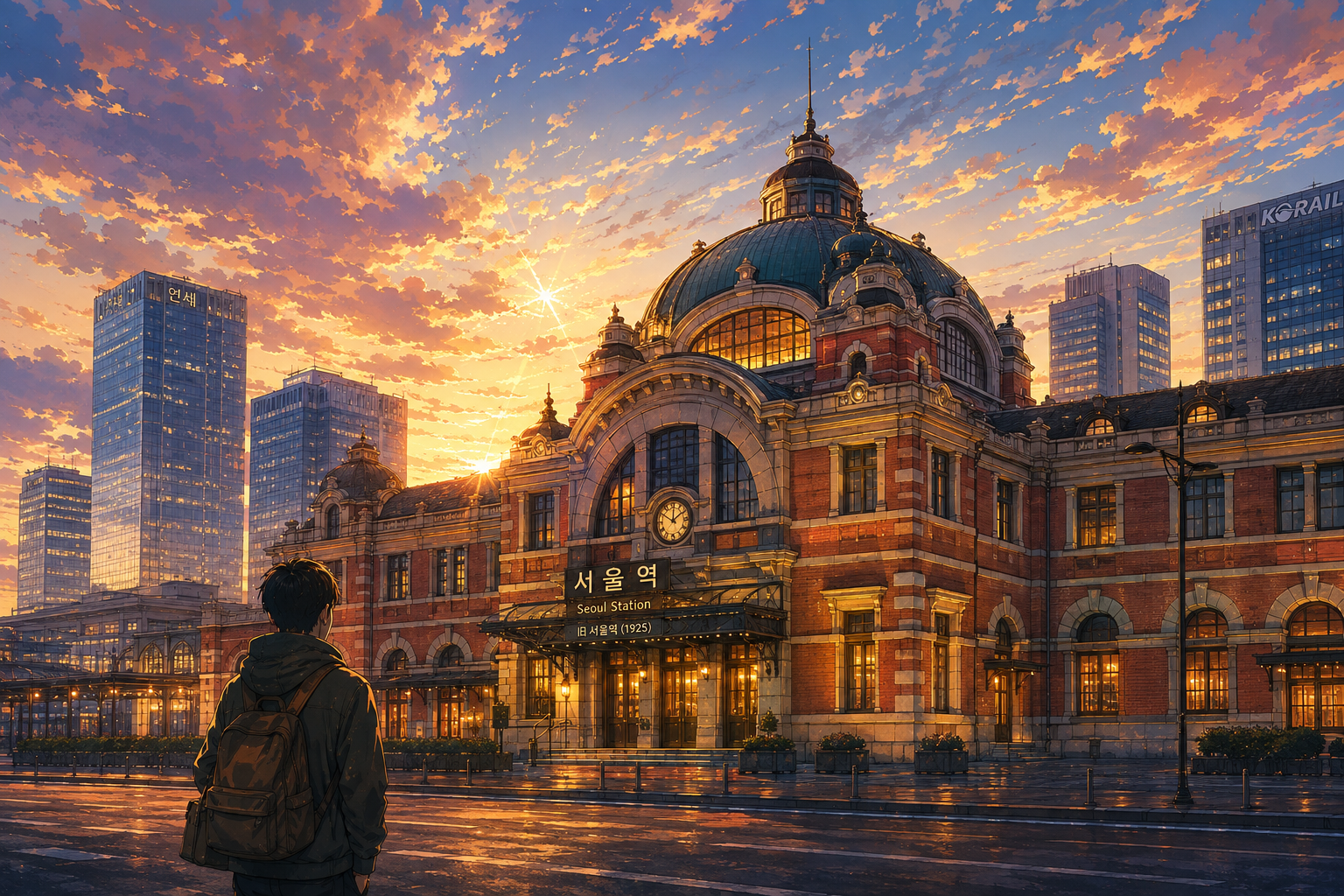
- If buildings had memories, this red-brick structure would hold every single scream and cheer of modern Korean history.
- It was once the beating heart of a massive railway network that pierced through the Korean peninsula and stretched across the Eurasian continent all the way to Paris and Moscow.
- But today, it remains the frozen terminal of the only divided nation on Earth, its tracks forever severed at the waist.
- The brutal exploitation of colonial rule, the burning tears of liberation, a devastating war, and a miraculous economic boom.
- A colossal 100-year trajectory is perfectly compressed inside this single building.
- In 1925, right in the middle of the Japanese colonial era, this Renaissance-style building was constructed under the name “Gyeongseong Station.”
- Modeled after the Lucerne Station in Switzerland with a magnificent Byzantine dome, it boasted the second-largest scale in the Orient at the time, trailing only Tokyo Station.
- The Japanese Empire used this station to ruthlessly extract resources from the Korean peninsula and as a logistical base for their invasion of the continent.
- At the same time, it was Joseon’s very first modern intersection, where “Modern Boys” and “Modern Girls” gathered to drink Western-style coffee and wear Western suits.
- On the day of liberation in 1945, this plaza became a sea of tears for countless returning compatriots shouting for joy as they reclaimed their homeland.
- However, that time of euphoria could not even last five years.
- When the Korean War broke out in 1950, this massive station became the target of brutal artillery fire, leaving its roof and splendid dome tragically blown away.
- The thick railway network that once freely crossed between North and South to reach the continent was permanently severed right at this point.
- In the 1970s, rising from the ashes of war, Seoul Station once again became the fierce basecamp stained with the blood and sweat of the Korean people.
- For millions of rural youths arriving in the capital with nothing but a ragged bundle to escape poverty, this was the first stage where the “Seoul Dream” began.
- The massive crowds that camped out for days, circling the entire plaza to get train tickets home for every major holiday, remains the most iconic scene of Korea’s economic growth era.
- In 2004, as the sleek, glass-palace-style new station was built right next door and the KTX (high-speed rail) era opened, this old red-brick building finally reached the end of its long lifespan as a train station.
- But instead of being demolished, the building went through a meticulous restoration process and was gloriously resurrected as a complex cultural space named “Culture Station Seoul 284.”
- The number 284 is taken directly from its official designation as Historic Site No. 284 of the Republic of Korea.
- The engines of the trains have stopped, but the heavy narrative this space holds has not.
- When the sunlight passes through the stained glass of the central hall and falls on the waiting room floor, you can almost hear the phantom footsteps of the tens of millions of people who passed through here.
- From the Gyeongseong Station of a colony to the Seoul Station of the modern era, this building is not just a transit stop; it is a giant train that has silently traveled through Korean modern history itself.
- Visiting this place is not merely about taking a photo with a pretty modern architectural backdrop.
- It is an overwhelming experience of walking directly into a 100-year time capsule of a nation at its most painful and most intense moments.
- If you had to explain the complex and dynamic modern history of Korea in a single shot, you must, without hesitation, guide them to this red-brick space.
Insider Playbook: Exploring Culture Station Seoul 284
Beyond a simple tour, here is a locally optimized playbook designed to provide the most multi-dimensional storytelling experience for international travelers.
| Category | Insider Tip |
| The VIP Room | Do not miss the VIP Room located deep on the first floor. This was an exclusive space reserved for the highest authorities of the time, including the imperial family of the Korean Empire and the Japanese Governor-General. The marble fireplace and luxurious chandeliers visually prove the sheer power of that era. |
| The First Western Dining | Head up to the second floor to find the traces of “Grill,” Korea’s first Western-style restaurant. With silverware settings that allowed 40 people to cut steaks simultaneously in the 1920s, you can imagine the exact scene where Western culture flowed in the fastest and most glamorous way. |
| Scars of War | During the restoration, they intentionally did not make the building look brand new. If you look closely at the outer walls and various spots inside, you can still find bullet marks and scorch marks from bombings during the Korean War, which serve as an incredibly powerful storytelling point. |
| The Perfect Aerial View | If you want to capture the contrasting panoramic view of the old Seoul Station, the modern new station right next to it, and the surrounding concrete jungle all at once, walk up to Seoullo 7017, an elevated highway turned pedestrian park. The night view of the old station looking down from here during the golden hour is the absolute best photo spot. |