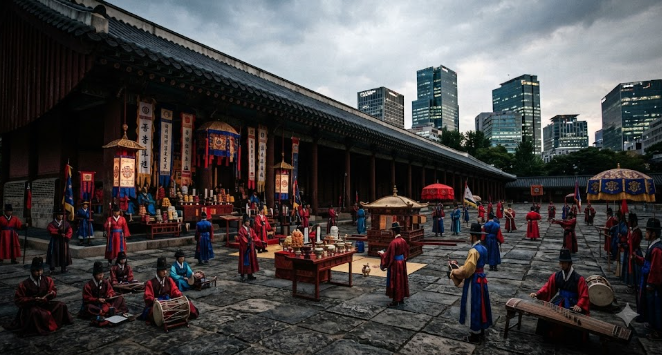
1. I have a bone-chilling, unapologetic obsession with the eerie, dead-silent interior of this UNESCO World Heritage site dropped right in the middle of Jongno.
2. While countless guidebooks call this place a grand ancestral shrine of the Joseon royal family, through the cynical eyes of someone who dragged foreign VIPs through the trenches of inbound tourism, this place is no mere relic.
3. It is a massive, inorganic “royal sanctuary” where spirits reside—a space in the middle of Seoul’s mega-city core that has not allowed the secular air of the living to mix for 600 years.
4. Western tourists go wild over the Changing of the Guard at Buckingham Palace or the glamour of the Louvre, but the reason I drag them down these rough stone walls in Jongno is to hit them with a completely different kind of shock.
5. The heavy silence that foreigners universally spit out the moment they set foot in this massive stone courtyard isn’t admiration for luxury, but a bizarre spiritual overwhelm they’ve never witnessed in Western history.
6. Jongmyo was never a palace where living kings resided; it was Joseon’s ultimate control tower, where the souls of dead kings supposedly lingered to grip and shake the nation’s breath.
7. The fact that right in the middle of 2026 Seoul, surrounded by a forest of skyscrapers, a massive “spiritual bunker” designed by King Taejo in the 14th century still stands intact is the most powerful noir plot twist.
8. Whenever war broke out or the country faced total collapse, Joseon kings ran straight to this shrine instead of the palace to drop to their knees in front of the ancestral spirit tablets.
9. In other words, this space was the ultimate decision-making situation room of supreme power, where the living and the dead negotiated state affairs under a chilling metropolitan heritage.
10. Facing the elongated corridor of Jeongjeon, the main hall of Jongmyo, your breath catches from a surreal, horizontal overwhelming scale unprecedented in world architectural history.
11. Those heavy wooden pillars stretching endlessly across 19 bays don’t just hold up a roof; they are the iron locks holding down centuries of accumulated curses and political energy from the Joseon royal family.
12. Western tourists marvel at the minimalist aesthetic, but to someone dissecting the historical underbelly in the inbound field, it looks like the world’s most massive and solemn “city of royal ghosts.”
13. The premise that the spirits of historical heavyweights—from King Sejong to King Sukjong, whose heart bled in the shadows of Jang Hui-bin—are stacked tightly inside this single corridor is far more thrilling than any Hollywood dark fantasy.
14. When King Sejo fled to Uiju during the Japanese invasions, what his subjects guarded with their lives wasn’t the royal seal, but the ancestral spirit tablets sheltered right here in Jongmyo.
15. That desperate obsession—that even if the country falls, the spirit tablets must survive—is the most primal proof of how thoroughly Joseon ran as a massive system powered by ancestral souls and capital.
16. The rough, square stone pavers underfoot inside Jongmyo are intentionally uneven, serving as a meticulous barrier to force living feet to bow their heads humbly along paths trodden by spirits.
17. Standing on this stark stone floor and explaining to Western travelers, “Your ancestors buried their tombs underground, but Joseon trapped royal souls collectively above ground and dumped massive national budgets into feeding them every year,” completely blows their minds.
18. The annual Jongmyo Daeje held every May is designated as a UNESCO Intangible Cultural Heritage, but the majestic ritual music and dance unfolding amid tourist cheers are actually a massive soul-consoling requiem for kings who passed away centuries ago.
19. The moment gongs, flutes, and solemn court music clash, the entire Jongmyo is completely cut off from modern Seoul’s noise, sucking you deep into a temporal time warp.
20. Surprisingly, foreigners refuse to believe such a space exists right next to Seoul’s skyscraper forest, and Western influencers who visit Jongmyo rave about it as “Seoul’s Secret Ghost Citadel.”
21. Tourists mistakenly misread Jongmyo as a pleasant urban park for a nice stroll, but this space is a cruel, breathtaking piece of political architecture soaked to the bone with Confucian blood and control.
22. The moment a king died, power shifted, but power’s legitimacy was only completely finalized when a new spirit tablet was enshrined at Jongmyo—acting as the ultimate sealing coat for royal authority.
23. Showing both the futility and eternity of power, this space offers the most chilling, powerful mental detox to modern people exhausted by the fast speed of capitalism amid corporate towers.
24. Having guided countless global VVIPs in the inbound sector, I’ve repeatedly witnessed how their eyes turn dead serious along these solemn stone walls of Jongmyo, far more than at flashy K-POP concerts or trendy Seongsu-dong cafes.
25. Outwardly quiet and boring, digging beneath the surface reveals it to be the true headquarters of “historical noir,” heavily oppressed by 600 years of royal conspiracies, sorrows, and the emptiness of absolute power.
[Insider Playbook: The Royal Ghost Walk]
26. Hit Exit 11 of Jongno 3-ga Station precisely at 2:00 PM, turning your back on the bizarre concrete skyscrapers of Sewoon Plaza to march straight toward Jongmyo’s grand main gate (Outer Gate).
27. The moment you cross the ticket booth and step inside, pause where the city’s noise abruptly cuts off like magic, absorbing the strange liberation where urban chaos clashes with spiritual silence.
28. Among the uneven Three Paths (the high central path for royal spirits and lower paths on both sides), deliberately avoid the central spirit path, walking strictly along the human paths on either side to maintain a quiet tension.
29. Stand right in the center of the massive stone courtyard (Woldae) in front of Jeongjeon, framing the endless 19-bay wooden corridor and the low sky above to capture a 15-second cinematic reels short-form clip.
30. Instead of exiting through the main gate when finished, take a slow walk toward Changdeokgung Palace along the quiet stone-paved outer walls surrounding Jongmyo, perfectly wrapping up the chilling stroll where Joseon kings once wandered.
Insider Playbook: The Royal Ghost Walk (Optimized Viewing Route)
- Hit Exit 11 of Jongno 3-ga Station precisely at 2:00 PM, turning your back on the bizarre concrete skyscrapers of Sewoon Plaza to march straight toward Jongmyo’s grand main gate (Outer Gate).
- The moment you cross the ticket booth and step inside, pause where the city’s noise abruptly cuts off like magic, absorbing the strange liberation where urban chaos clashes with spiritual silence.
- Among the uneven Three Paths (the high central path for royal spirits and lower paths on both sides), deliberately avoid the central spirit path, walking strictly along the human paths on either side to maintain a quiet tension.
- Stand right in the center of the massive stone courtyard (Woldae) in front of Jeongjeon, framing the endless 19-bay wooden corridor and the low sky above to capture a 15-second cinematic reels short-form clip.
- Instead of exiting through the main gate when finished, take a slow walk toward Changdeokgung Palace along the quiet stone-paved outer walls surrounding Jongmyo, perfectly wrapping up the chilling stroll where Joseon kings once wandered.